
China’s QR-Code Payments Remade Everyday Transactions in a Decade
A small QR code reshaped the way Chinese people pay, receive money, and run everyday transactions.
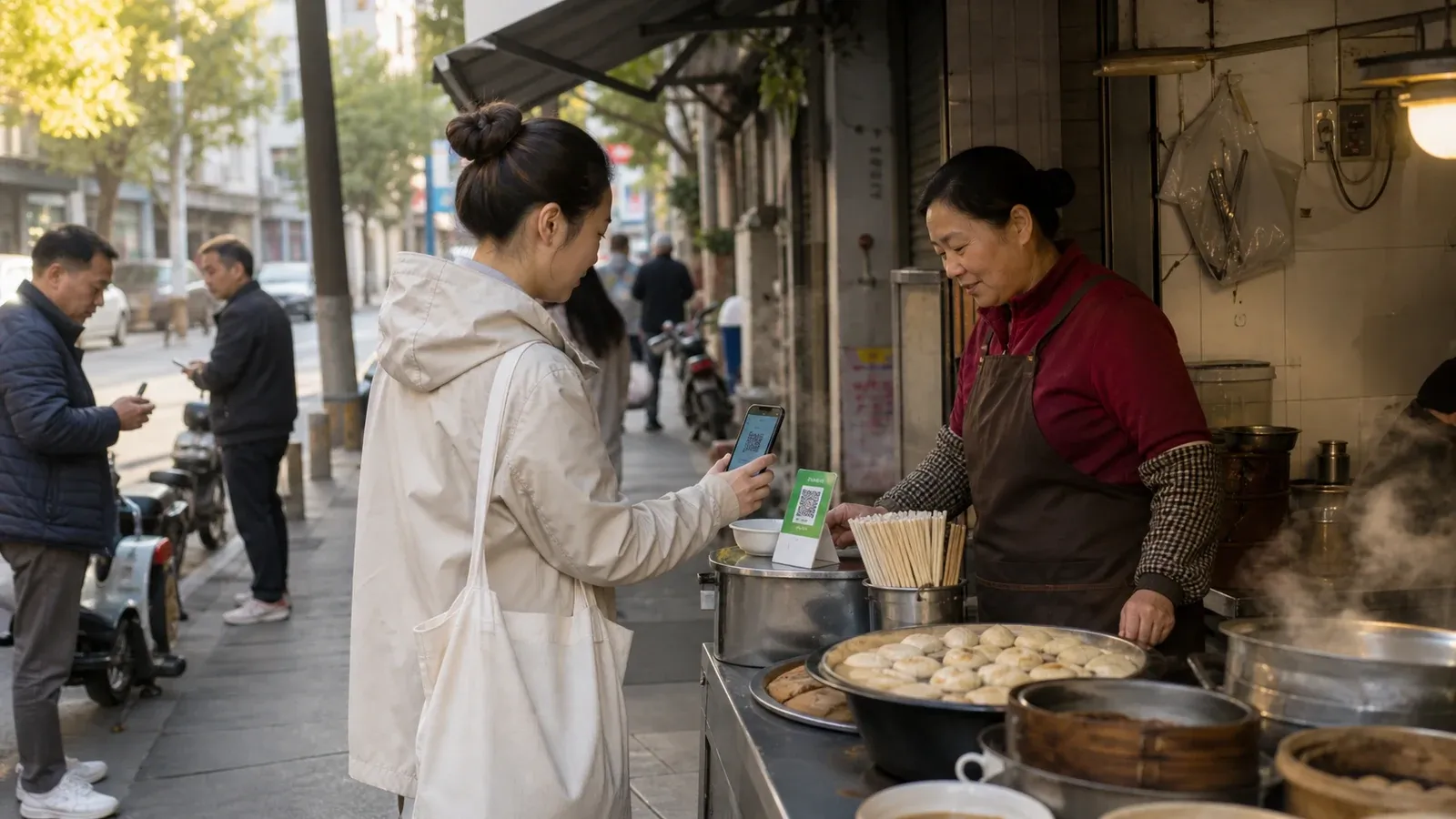
When buying breakfast on a Chinese street, customers often do not ask, “Can I pay by card?” They simply take out their phones and scan the QR code on the table. The person receiving the payment may work for a chain store, or may be a vendor selling jianbing from a cart. Once the payment notification sounds on the phone, the transaction is over.
China did not skip cash and bank cards. Chinese people used cash for a long time, and bank cards had already become widespread. The change brought by QR codes was that they took digital payments into small transactions where card machines had previously been difficult to use. They are cheap, easy to set up and suited to the vast number of small merchants in Chinese cities.
Why QR Codes Spread Faster Than Card Machines
Traditional bank-card payments require merchants to install terminals, connect to acquiring services, and deal with equipment maintenance and transaction fees. Large shopping malls and hotels can do this, but market stalls, mobile shops and individual operators may not be willing to bear these costs.
QR codes greatly lowered the threshold. A merchant creates a payment code linked to an account, prints it out, and can begin receiving payments. Customers use their own phones to scan it, enter the amount and confirm the payment; merchants do not need to operate complex equipment. Payment codes can also be placed on counters, dining tables or even a plastic sign, regardless of the size of the business.
This also explains why QR-code payments first gained a foothold in frequent, small transactions. Breakfast, taxis, fruit stalls and splitting restaurant bills among friends all involve small amounts, but happen every day. Once several shops on the same street begin using them, customers become used to scanning codes, and other merchants are more willing to join.
Payment Apps Were Already on People’s Phones
Alipay was initially closely associated with online shopping, while WeChat first became an important tool for daily communication among Chinese people. After payment functions were added, online orders, transfers in chats, red envelopes and offline purchases all entered two platforms that Chinese people already knew well. QR-code payments did not require users to buy another device; they only needed to open a feature in an app they already used.
In the middle of the 2010s, mobile red envelopes during the Spring Festival led many Chinese people to link bank cards to WeChat for the first time. The red envelopes might contain only a few yuan, but they turned what had been a serious financial operation into an interaction among relatives and friends. Many people first learned to grab red envelopes and transfer money, and only later began scanning codes in shops.
The change in payment methods also affected how merchants operate. Payment records can be linked to memberships, coupons and online orders; restaurants put ordering codes on tables, so customers can scan once to choose dishes, place an order and pay. To learn more about how phones connect Chinese people to transport, food ordering and everyday services, read [[Why Is It Really Possible to Go Out in China Carrying Only a Phone?]].
QR-Code Payments Now Work in Several Ways
Today, when Chinese people say “scan to pay,” they may actually mean two different directions. Small shops often have customers scan the merchant’s fixed payment code; in supermarkets and convenience stores, cashiers scan the dynamic payment code on the customer’s phone. Some places also use tap-to-pay, palm scanning or the digital renminbi, but QR codes remain the easiest method for merchants of different sizes to adopt together.
The spread of mobile payments has also exposed new inconveniences. When a phone runs out of power, an account has a problem or the network is unstable, payment can suddenly become difficult. Older people, people unfamiliar with smartphones and foreign visitors making short trips to China may not be able to complete registration and verification as smoothly as regular local users.
In recent years, foreign users have been able to link more international bank cards to Alipay or WeChat Pay, and major tourist sites have also been improving bank-card and cash services. The exact scope of support, limits and verification requirements may still change, so travelers should check the platforms’ latest instructions before departure.
Cash Has Not Disappeared; It Is Just Not Always the First Choice
Renminbi cash remains legal tender in China, and merchants cannot casually refuse cash simply because they are used to QR-code payments. Bank cards also continue to be used for large payments, banking services and situations where using a phone is inconvenient. The phrase “cashless society” sounds simple, but can easily obscure differences among ages, regions and groups of people.
A more accurate description of the change over the past decade is that the default order of everyday payments in China has changed. In the past, people first checked whether they had enough small change; now many Chinese people first check whether their phone has power. QR codes did not eliminate cash, but brought digital payments into the smallest and most ordinary transactions.
References
- Payment service guide for overseas visitors to China (China Government Website, 2024) - China further streamlines mobile payments for foreigners (China Government Website, 2024) - Payment Service Guide for Overseas Users in Shenzhen (People’s Bank of China Shenzhen Branch, 2024) - China: A Digital Payments Revolution (CGAP)

Peng Jinsui
I explore Chinese society, culture, travel, business, and language learning while studying Spanish and experimenting with AI and interactive products. I’m also open to helping people and organizations overseas better understand China, connect with local resources, and address practical needs.
Peng Jinsui