
Electric Vehicles Are Entering Ordinary Chinese Households
For Chinese buyers, electric vehicles are changing from a new technology into an ordinary family car.
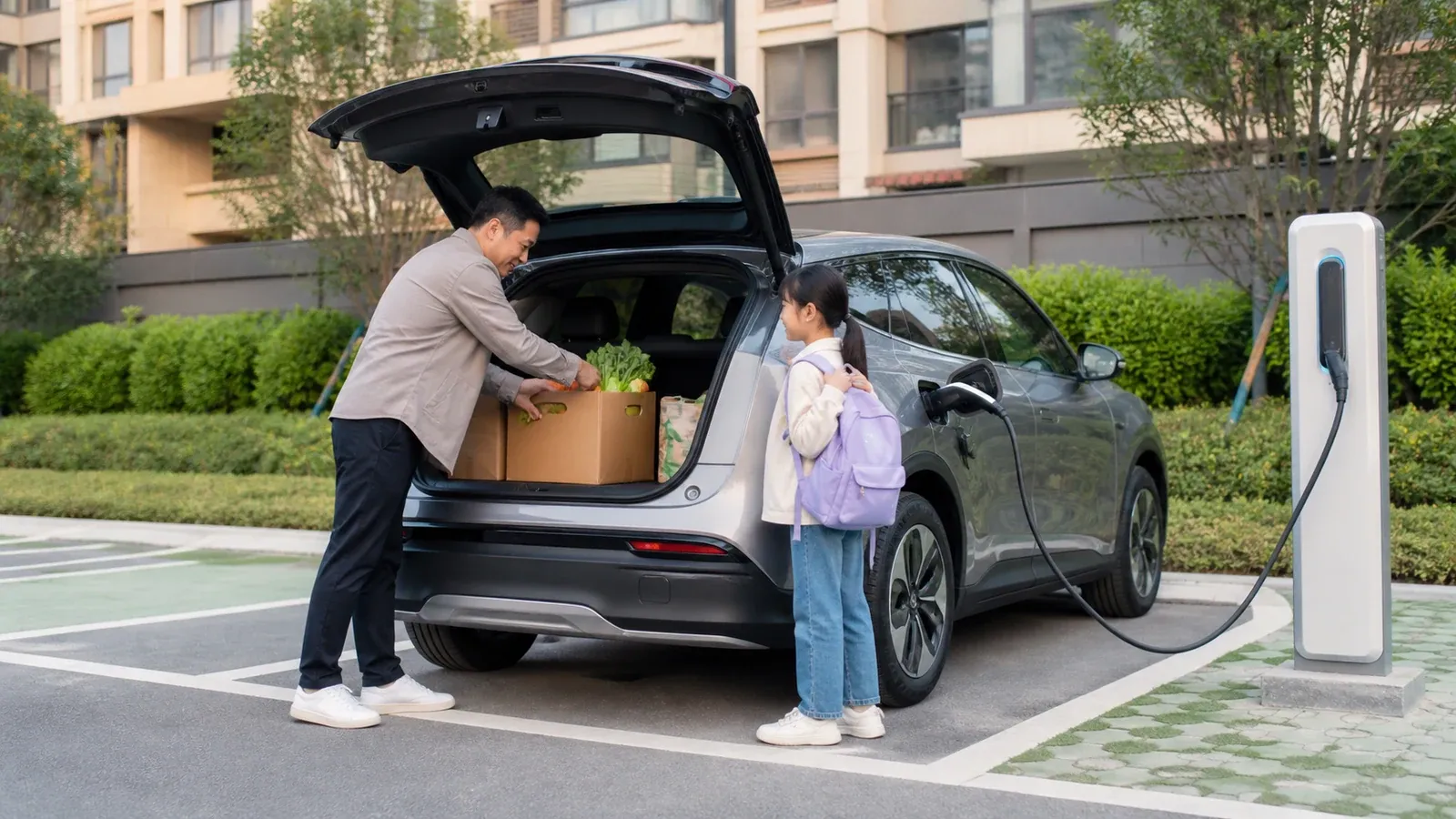
In the parking lots of new residential compounds in Chinese cities, domestically produced electric vehicles are no longer easily seen as an experiment for a small minority. Picking up the children, commuting to and from work, and taking short weekend trips—these cars serve the same purposes as gasoline-powered family cars. When many families compare their next car, they no longer first ask, “Should we buy an electric vehicle?” Instead, they put several battery-electric, plug-in hybrid or range-extended models side by side to calculate prices and costs of use.
In 2024, nearly half of new cars sold in China were electric vehicles. By 2025, this share had approached 60 percent. Environmental awareness alone cannot explain this change, and no single carmaker could have achieved it. Prices, models, charging conditions and China’s domestic supply chain changed car-buying choices together.
“Electric Vehicles” Are Not One Kind of Car in China
When foreign readers see China’s new-energy-vehicle figures, the first thing to check is the statistical definition. In China, “new energy vehicles” usually covers battery-electric vehicles, plug-in hybrids, and range-extended electric vehicles. All can be charged externally, yet they fit different patterns of use.
Battery-electric vehicles rely entirely on batteries and suit people with stable charging conditions at home or work. Plug-in hybrid and range-extended models can use electricity when charging points are available, while also relying on fuel for long journeys or when charging is inconvenient. For families worried about long holiday journeys, the latter two options reduce the pressure of changing habits.
This range of products is important. Chinese families can choose among a “traditional gasoline car,” a fully battery-electric vehicle, and several middle options, depending on their housing, commute, and long-distance travel needs.
Prices No Longer Belong Only to the High-End Market
China’s electric-vehicle market includes both expensive large SUVs and small cars suited to everyday travel. In 2024, about two-thirds of battery-electric vehicles sold in China were already priced below the average price of comparable gasoline-powered cars. Electrification is especially evident in the small-car market, where consumers can find products across a wide price range.
Falling battery costs and a mature domestic supply chain have lowered vehicle prices. Intense competition has also forced automakers to update features frequently, bringing cabin screens, driver assistance, remote air-conditioning and voice control—once seen only in expensive models—into more ordinary vehicles.
Purchase subsidies no longer determine the market as they did in the early years, but vehicle-purchase-tax incentives, trade-in policies and license-plate rules in some large cities still affect how families calculate total costs. Among 2024 applications for vehicle trade-ins, consumers choosing electric vehicles made up the majority.
Charging Conditions Determine Whether a Car Is Really Convenient
For families with a fixed parking space and a private charging point, the logic of using an electric vehicle is simple: plug it in when parking at night, and there will be enough charge when leaving the next day. Charging takes place while people sleep, so owners do not need to make a special trip to a gas station.
Problems often arise here as well. Older residential compounds may lack fixed parking spaces, and installing a private charging point also involves property management, electrical capacity and parking-space ownership. Owners who rely on public fast charging need to consider queues, prices and charging-station locations. During peak periods for long-distance travel, such as the Spring Festival, waits may still occur at popular expressway service areas.
Experiences differ greatly across China. Pure electric vehicles are easier to use in southern cities, dense urban clusters and areas with mature charging networks; winter range in cold regions and the distance between charging options in remote areas make some families more inclined to choose plug-in hybrids, range-extended vehicles or gasoline-powered cars.
Chinese Families Are Also Buying a Set of Digital Products
Many Chinese electric-vehicle brands treat cars as software terminals that can be continuously updated. Owners can check battery levels, turn on air conditioning in advance and look for charging points on their phones, and they also receive system updates. The sales process has changed too: brand-operated stores have entered shopping malls, and test-drive appointments and vehicle configurations can be completed in apps.
These functions appeal to consumers accustomed to smartphones, but they also bring new issues. The names used for driver assistance can make people overestimate a vehicle’s capabilities, software failures can affect functions originally unrelated to the car, and repair and insurance costs also vary by model. Price wars also make some owners worry that the car they just bought will quickly become cheaper.
Electric vehicles entering ordinary Chinese households does not mean gasoline-powered cars will disappear immediately. The practical change is that EVs have become a standard option in the car-buying conversation. Chinese families compare batteries, charging, and software alongside space, fuel consumption, and brands. At that point, EVs are part of ordinary household planning, not just technology news.
References
- Global EV Outlook 2026: Executive summary (International Energy Agency, 2026) - Global EV Outlook 2025: Trends in electric car markets (International Energy Agency, 2025) - Global EV Outlook 2025: Trends in affordability (International Energy Agency, 2025)

Peng Jinsui
I explore Chinese society, culture, travel, business, and language learning while studying Spanish and experimenting with AI and interactive products. I’m also open to helping people and organizations overseas better understand China, connect with local resources, and address practical needs.
Peng Jinsui