
Taking a Robotaxi in a Chinese City Is No Longer a Vision of the Future
Robotaxis are already on the road. For now, they stay within designated areas and operate under strict rules.
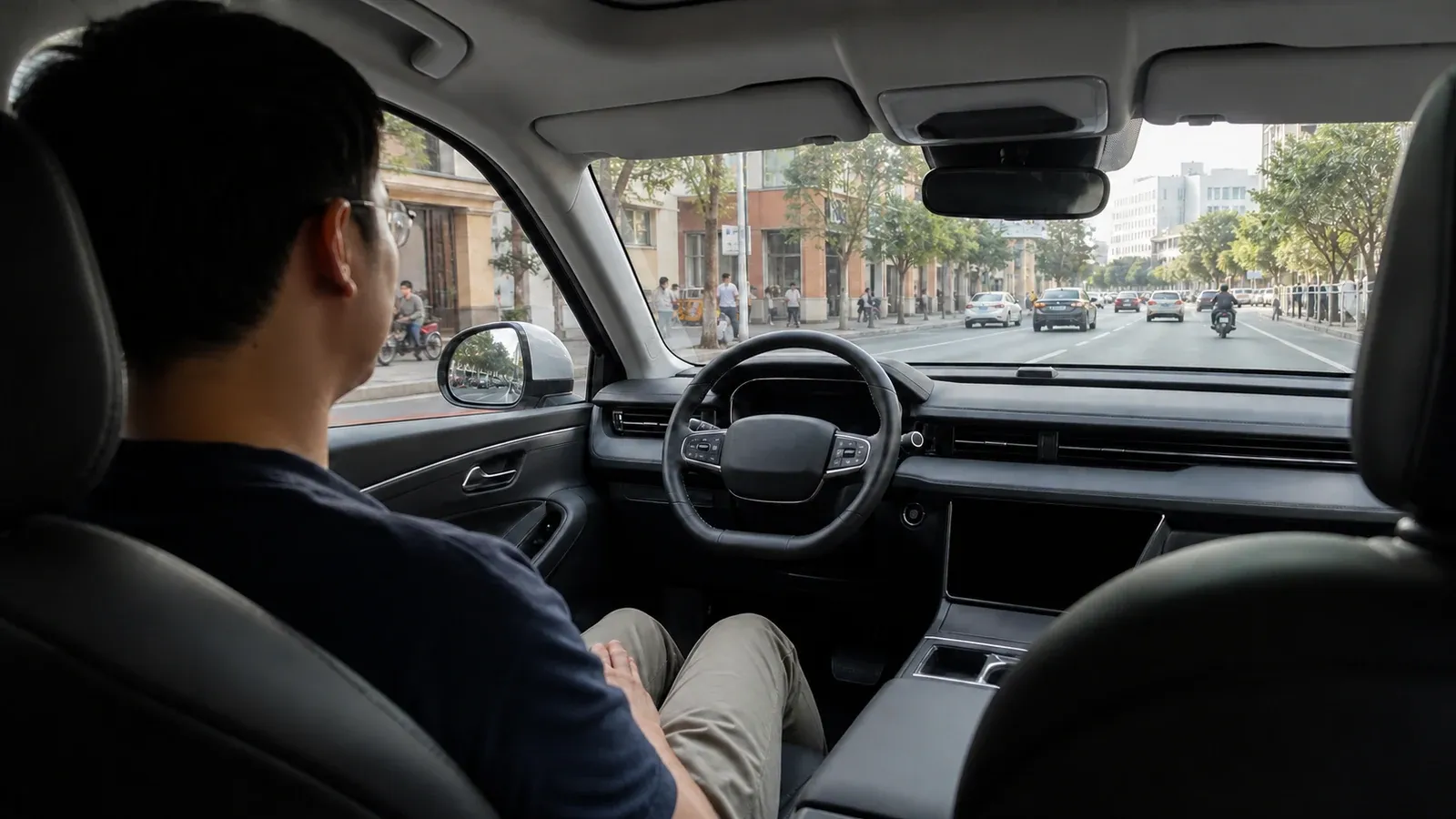
In some parts of Wuhan, passengers can use a mobile app to call a taxi with no safety operator sitting in the driver’s seat. After the vehicle arrives, passengers unlock the door with their phones, confirm the trip on a rear-seat screen, and then watch the steering wheel turn on its own. First-time riders often keep their eyes on the road ahead: Will the vehicle yield to pedestrians? How will it go around a temporarily parked car? Will it brake suddenly at a complicated intersection?
Such services have already reached parts of the roads in cities including Beijing, Wuhan, Shenzhen, Guangzhou and Shanghai. They show that autonomous driving is no longer confined to closed test sites, but they do not mean autonomous cars are already in general use across Chinese cities. Operating areas, hours, pick-up and drop-off points, and weather conditions all have clear restrictions.
First, Distinguish Driver Assistance From Robotaxis
More and more new cars on Chinese roads have functions such as lane keeping, automatic parking and highway navigation. Most mass-produced cars of this kind still provide driver assistance: the driver must stay attentive and be ready to take over at any time. “Smart driving” in promotional material does not mean that a vehicle can independently take responsibility on any road.
Robotaxi pilots use another operating model. Vehicles, roads and back-end systems are all subject to supervision, and the service normally opens only in areas that have been mapped and approved. Some vehicles have an in-car safety operator; some no longer have a person in the driver’s seat, but remote support staff still handle exceptional situations from the back end.
Therefore, an empty driver’s seat does not mean that the vehicle has left its operations center behind. It continually sends back vehicle-status and road information, and may request remote assistance when it encounters roadworks, an accident or a situation it cannot assess.
Why These Cities Opened First
For a vehicle to operate on the road, it also needs high-definition maps, stable communications, road-testing rules, data management and arrangements for accident liability. Local governments need to designate operating roads and decide how vehicles qualify for testing or commercial service.
Wuhan has opened a relatively large area with varied road types, making it one of China’s robotaxi pilots most easily noticed by ordinary passengers. By October 2024, more than 400 fully driverless taxis had entered relevant local services. Beijing implemented new rules on autonomous vehicles in 2025, providing clearer local rules for scenarios including personal travel, public transport and road transport.
These cities’ willingness to test is also related to China’s existing electric-vehicle industry. Electric platforms make it easier to install sensors and computing equipment, while domestic supply chains can provide lidar, cameras, chips and complete vehicles. The large number of ride-hailing users means that mobile ride-hailing and platform billing do not require the market to be educated again.
Why the Ride Feels Both New and Ordinary
The process of calling a vehicle resembles ordinary ride-hailing: passengers choose permitted pick-up and drop-off points, the system dispatches a vehicle and displays the waiting time. Inside the car, the most obvious difference is that there is no driver to speak with; air conditioning, music, door opening and trip confirmation are all handled through a screen or voice.
Vehicles usually drive conservatively. They may slow down earlier than a human driver, keep a greater distance from the vehicle ahead, and wait because they are uncertain about a roadside vehicle or a pedestrian’s movement. For passengers, this caution sometimes brings a sense of safety and sometimes makes the ride feel slow. Complex intersections, temporary roadworks and other vehicles that do not follow the rules remain the situations that test the system most.
Prices during the pilot stage may include discounts and cannot be used directly to judge how much cheaper robotaxis will be than ordinary taxis in the long term. Vehicles require expensive equipment, maintenance and back-end support; long-term costs will become clearer only after operations expand in scale.
How Far Is It From Being Available Everywhere?
The most obvious current limit of robotaxis is geofencing. Passengers can choose points only within designated areas, and a stretch of road that looks ordinary may be unavailable simply because it has not been approved. Heavy rain, snow, road changes and large events all make operations more difficult.
Questions of responsibility are equally important. When an ordinary taxi has an accident, the driver and operating company each have clear roles; autonomous vehicles involve the vehicle manufacturer, the autonomous-driving-system provider and the operating platform, requiring more detailed records and rules. The public will also care about what cameras collect, what remote staff can see, and how professional drivers will be affected.
The autonomous-driving experience in Chinese cities is already real, but it is more like a gradually expanding public-road experiment. Passengers can sit in the vehicle, and cities are also using every trip to test technology, regulation and public acceptance. A steering wheel turning by itself is only the most visible scene; the system that limits where, when and how it operates is what determines whether robotaxis can become everyday transport.
Related Video Recommendation
https://www.youtube.com/watch?v=FwABzdr5elM
References
- China's burgeoning autonomous driving industry fuels robotaxi use (State Council Information Office of the People’s Republic of China, 2025) - Self-driving cars speeding toward market (Wuhan Municipal People’s Government, 2025) - Can China repeat its EV success with robotaxis? (BBC, 2025)

Peng Jinsui
I explore Chinese society, culture, travel, business, and language learning while studying Spanish and experimenting with AI and interactive products. I’m also open to helping people and organizations overseas better understand China, connect with local resources, and address practical needs.
Peng Jinsui