
The Disciplined Performativity of Children in East Asia
When parents become directors and Confucian ethics becomes the script, when can children finally call it a wrap on the role someone else wrote for them?
2026-08-20
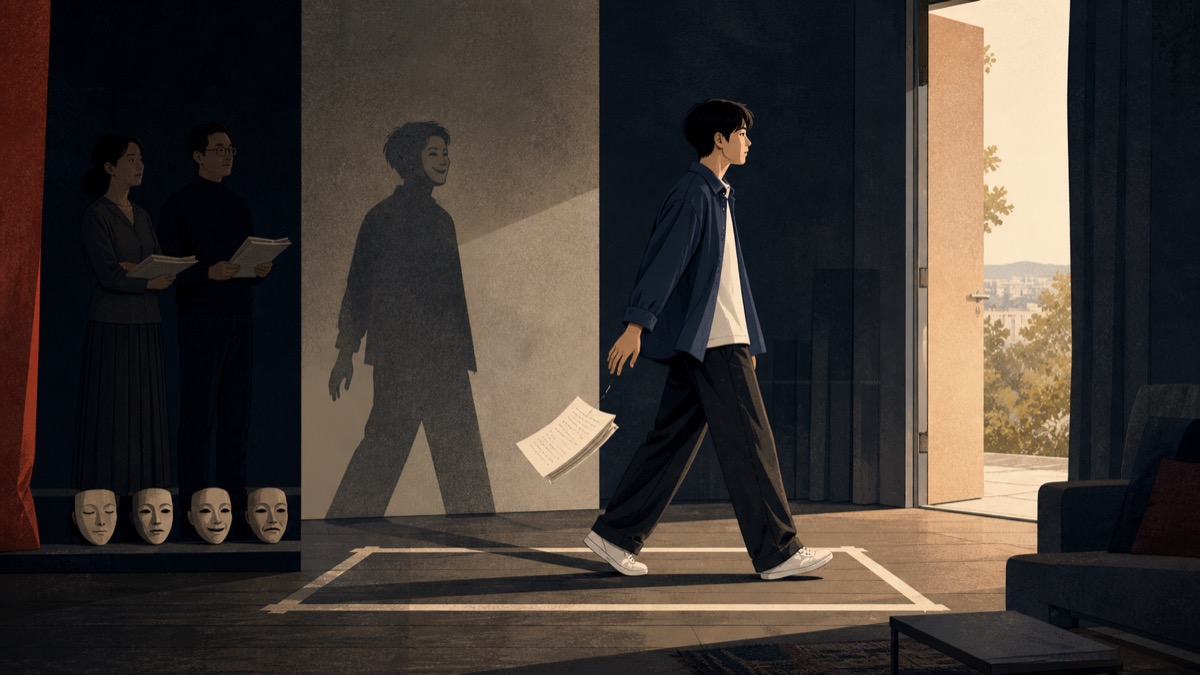
Children across East Asia exhibit a kind of disciplined performativity. From their earliest memories, they are expected to perform gentleness, kindness, courtesy, frugality, and deference. If they cannot, it is “NG”—no good. Another take. Wielding authoritarian power and imposing their own values, parents become the household’s “directors.” With Confucian ethics serving as the script outline, they demand that their children play a different, socially appropriate part for every occasion.
If the performer is a natural, follows the “script outline,” and plays the part well, the director saves time and trouble. If the performer cannot act—or performs so badly that some scenes become impossible—the director steps in to demonstrate: what identity to assume, what convictions to hold, what expression to wear… If the performer still cannot deliver after the demonstration, a director with means and resources finds another route. If the performer is not up to it, bring in technology: use “eye drops” to pass false tears off as real, or pile on the special effects and move the production to another arena.
Another kind of performer gives the director the greatest headache: one who can act but refuses to follow the script. Such a performer is branded as thoroughly “disobedient” and “immature.” Disobedience itself is recast as another form of “incompetence.” The director then enjoys two immense forms of gratification: exercising authoritarian power and imposing their values. They use that power to correct the “noncompliant” performer and beat them into submission, forcing them to follow the “script outline.” In the process, they belittle the performer’s “noncompliance,” define it as incompetence, subject the performer to another round of brainwashing, and reshape the performer’s values.
The director is determined to beat this kind of disobedient performer into submission—to make an example of one as a warning to a hundred, to “kill the chicken to scare the monkeys.” That settles things once and for all while securing several gains at a stroke: a can’t-lose proposition. Once the performer has been beaten into submission, they become dependent on the director for life. “Look at the world outside! Wolves are circling everywhere. How dangerous it is! How merciful the director is, to deliver you from peril.” The performer feels grateful and, at the same time, guilty for having been “disobedient” and for “not knowing any better.” They naturally pledge body and soul to the director, bound to them for all eternity. Only two kinds of performance enter the performer’s repertoire, and they will perform them for the rest of their life: the “model operas” of the Cultural Revolution and Sichuan opera’s face-changing act.
In short, in East Asian families, the director must be the one who succeeds; whether the performer does is beside the point. If the performer makes it, the director looks brilliant. If the performer fails, the director can swap in another sibling at any time—or start over with a fresh alt account, this time using a niece, nephew, or grandchild. Either way, the director’s prestige remains intact. Sometimes it is precisely the performer’s “incompetence” that allows the director to display powers that seem almost supernatural.
When will the performer realize that scripts, too, are written by people? If they can no longer perform for someone else—or can no longer do it well—they can walk off the set and stop acting. They can play only the scenes they do best, love most, and most want to play. Or they can simply call it a wrap on the part someone else wrote for them, shed the skin of performativity once and for all, rewrite their own script, and become the director of their own life.
Originally published in Chinese on Xingzhou.press on June 20, 2025.
Xing Zhou
From the Hangzhou–Yiwu corridor, I write and host the Golden Age podcast about young Chinese people venturing into the world, the changing ties between China and Latin America, and how ordinary people can gain more choice in times of change.
Xing Zhou