
Why Can Chinese Local Opera Still Attract Young Audiences?
The gongs, drums, dialects, and stylized movements of the opera stage have not disappeared. They have changed the theatres, cameras, and ways in which they meet audiences.
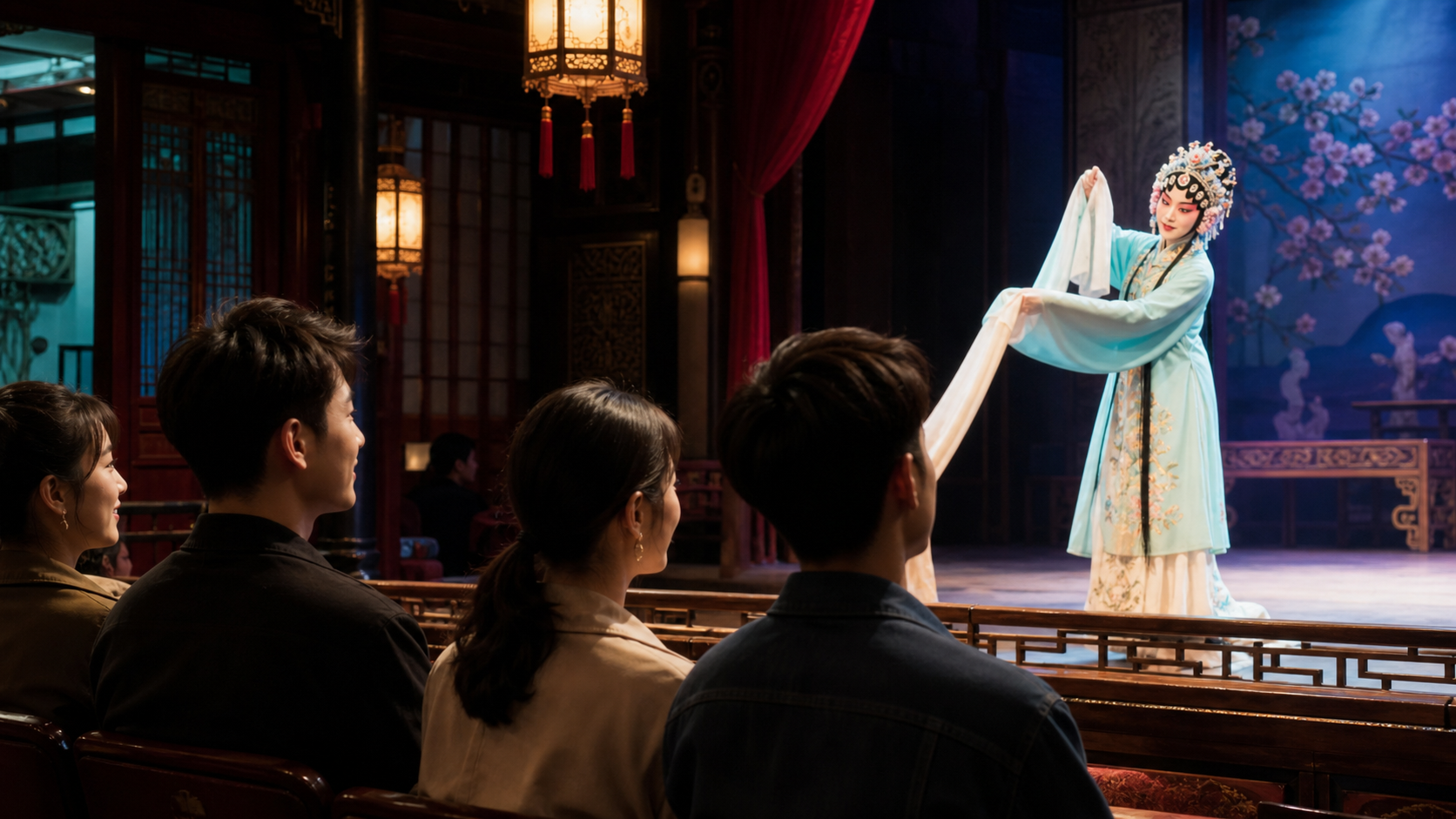
The gongs, drums, dialects, and stylized movements of the opera stage have not disappeared. They have changed the theatres, cameras, and ways in which they meet audiences.
When Chinese people say “opera,” they are referring to a group of different genres. Peking Opera, Kunqu, Cantonese Opera, Yu Opera, Yue Opera, Qin Opera, and many local forms all use different languages, vocal styles, rhythms, and stories. They are often connected to the accent, festivals, and community life of a particular place. A foreign audience member watching Peking Opera in Beijing hears a different tradition from someone watching Yu Opera in a Henan township.
Young people’s renewed interest in opera does not necessarily mean that they have suddenly begun listening to complete old plays every day. Many first see a singing excerpt in a short video, or stop because of an actor’s movement, makeup, or costume, and only then look for a full performance. Short videos open the door; live performances, school clubs, and opera films determine whether the interest continues.
Why local opera cannot be treated as a museum object
The China Intangible Cultural Heritage Network describes opera as an integrated performing art and a tradition that continues to change. The same play is never exactly the same each time. The actor’s choices, dialect pronunciation, audience response, and conditions at the venue all affect the result. Opera is completed through the face-to-face relationship between performers and audiences.
That is also what makes opera difficult to preserve. If old vocal styles, scripts, and costumes are simply stored, researchers may have an archive without having a living theatre. In the past, stages could be set up at temple fairs, teahouses, or open spaces in villages. Modern audiences are more likely to enter theatres with lighting, seats, and subtitles. A change of venue does not necessarily damage a tradition. The key question is whether its vocal style, performance logic, and local character can still be learned and used.
Local opera also has a feature that is often overlooked: it tells stories about family relationships, choices in marriage, conflicts among neighbours, and the wishes of ordinary people. Even if foreign audiences do not know the background, they can begin by watching how characters argue, wait, apologize, or make decisions. Dialects may be difficult, but rhythm, eye movements, and gestures offer another set of clues.
Where young audiences enter the world of opera
For young people, entering opera usually requires a small first step. A complete play may last several hours, and its lyrics and historical background may need notes. A one-minute excerpt of a stylized movement can first show the actor’s control. When a 2021 Douyin report on intangible-heritage theatre was covered by China Central Television, it said that views of intangible-heritage theatre videos had doubled year on year and that viewers born in the 1990s and 2000s made up more than half. Short-video data cannot be equated with the number of live audience members, but it shows that opera has entered young people’s everyday feeds.
Many troupes prepare introductions, subtitles, and edited performances for new audiences. Some place classic arias alongside modern stage design; others collaborate with jazz, rap, or contemporary music. Such adaptations require a fresh look at how to make the language audible, the movements legible, and the genre worth exploring further. Effective crossover keeps opera’s rhythm and performance methods instead of using a single costume as decoration.
Social media has also changed the distance between actors and audiences. In the past, viewers left after a performance. Today they can hear an actor talk about makeup, training, and roles in a livestream, or watch mistakes during rehearsal. Young people are more easily drawn to specific individuals: an actor who spends years mastering one movement can make “tradition” more convincing as a person’s work. For foreign audiences, this backstage material also explains what opera contains. It is a story, but it is also physical training and a teacher-student tradition.
What to notice when watching local opera
When watching for the first time, there is no need to identify every character immediately. First observe how the characters enter the stage: different identities have different steps, postures, and pauses. Then listen to how the ensemble follows the actor; the gongs and drums often signal an emotional turn. Finally, notice how a fan, a sleeve, or a turn can stand in for a real object. An opera stage may be sparse, but an actor’s movements can turn an empty space into a palace, courtyard, or battlefield.
It is also fine to accept that some of it will remain difficult to understand. Subtitles can help with the plot, but they cannot fully replace the music of a dialect and a vocal style. You can start with an excerpt that includes an introduction, then look for a complete performance by a local troupe. Local opera attracts young audiences through distinctive sounds and physical language, and through new channels that bring people to the theatre. A tradition can continue only if people are still willing to perform it on a stage today.
https://www.youtube.com/watch?v=Sp0g8xf2mO4
References
- The Protection and Inheritance of Opera as Intangible Cultural Heritage (China Intangible Cultural Heritage Network) - Traditional Opera Is Winning Young Fans (China Central Television)
Peng Jinsui
I explore Chinese society, culture, travel, business, and language learning while studying Spanish and experimenting with AI and interactive products. I’m also open to helping people and organizations overseas better understand China, connect with local resources, and address practical needs.
Peng Jinsui