
Why Do Chinese Parents Remain So Involved in Their Adult Children’s Lives?
Adulthood does not erase family responsibilities. In many Chinese families, closeness brings support, expectations, and ongoing negotiations over boundaries.
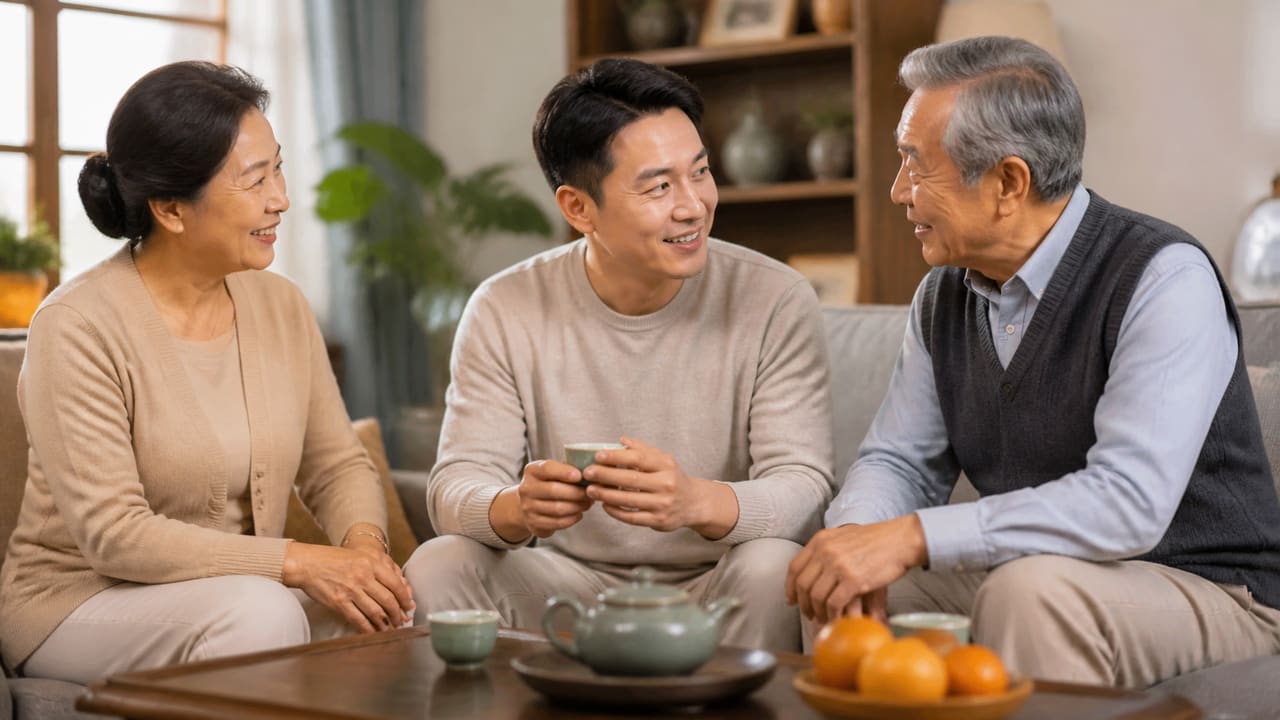
A thirty-year-old Chinese person may already have left home for work, yet their parents may still ask what time they finish work, whether they are dating, and when they will buy a home. At the same time, the parents may help with a down payment, care for a child, or offer a home to return to when their adult child changes jobs.
Foreign readers may notice only that “parents interfere a lot” and overlook the other side of the relationship: intergenerational ties in Chinese families often include both intervention and long-term, concrete exchanges of resources. They cannot be understood through only the labels “independent” and “dependent.”
Adulthood Is a Legal Milestone, Not Necessarily a Family Boundary
In some societies, moving out after turning eighteen is seen as an important sign of independence. Chinese families more often understand growing up as a gradual process. Going to university, finding a job, marrying, and having stable housing may change family roles more than an eighteenth birthday.
High housing costs and migration between cities also make independence expensive. It is not unusual for parents to help pay for education, a down payment, or a wedding. After an adult child accepts help, parents often feel they have a reason to participate in major decisions. Money, care, and opinions are difficult to separate completely.
This does not mean that all Chinese young people depend on their parents. Many live alone in another city and support themselves financially, yet still contact home every day and tell their parents about important decisions. Emotional closeness and practical independence can exist at the same time.
Support Goes Both Ways, Just at Different Times
Chinese families often view intergenerational responsibility over a long period. Parents invest housing, care, and savings while their children are young; adult children later provide companionship, medical help, and elder care. This exchange is not settled item by item on the spot. It is more like family cooperation across several decades.
The relationship often grows tighter after grandchildren are born. Grandparents help with school runs, cooking, and childcare so that young parents can continue working; younger families also handle older relatives’ medical arrangements and digital-life problems. Three generations may live in different homes and still depend heavily on one another.
Of course, long-term support can become pressure. If parents use financial help as a reason to control choices, children may feel indebted; if children treat grandparents’ help as an obligation, the older generation may also become exhausted. A close relationship is not automatically harmonious.
Why Do Questions About Relationships Always Appear in Family Conversations?
Marriage in Chinese families is often seen at the intersection of personal choice and family continuation. Parents worry that their children will lack a partner to care for them later, and they may also care about how relatives judge the family’s situation. As a result, questions about dating and marriage during Spring Festival reunions can become a fixed source of pressure for young people.
The generational disagreement is growing. Young people place more value on relationship quality, personal timing, and financial preparation, and do not want to marry simply to meet a timetable. Their parents’ experience comes from an earlier social environment in which a stable family was expected to be established quickly. The surface argument is about age; underneath it is a different understanding of security.
New Boundaries Are Taking Shape
More adult children are beginning to tell their parents which subjects can be discussed and which decisions they will make themselves. Some parents are also learning to reduce reminders and replace direct arrangements with choices they can offer. Family groups, video calls, and short visits keep contact frequent without requiring people to live together.
Boundaries are not coldness. For many Chinese families, the ideal is not to withdraw completely from one another’s lives, but to be able to show up when needed without making every decision for the other person. This balance is not settled in one conversation; it is repeatedly adjusted around work, marriage, childbirth, and elder care.
The close contact between Chinese parents and adult children has cultural roots as well as practical causes in housing, childcare, and aging. It can provide a powerful safety net, but it can also create heavy expectations. What is changing is not that Chinese families have suddenly stopped being close, but that a younger generation is asking for closeness to continue while adults’ right to choose is also recognized.
https://www.youtube.com/watch?v=hKDUbiibsNQ&t=59s
References
- Changes and Continuities in Contemporary Chinese Family Structure and Intergenerational Relations (People’s Daily) - Intergenerational Functions and Their New Changes in Chinese Families (Population Research) - The Value Shift Behind the Rise of New Family Relationships (People’s Tribune, 2026)

Peng Jinsui
I explore Chinese society, culture, travel, business, and language learning while studying Spanish and experimenting with AI and interactive products. I’m also open to helping people and organizations overseas better understand China, connect with local resources, and address practical needs.
Peng Jinsui