
Why Does Chinese Calligraphy Still Have a Life in the Digital Age?
Phones have made people less likely to write long letters by hand, but they have not pushed calligraphy out of life. It has found new places in classrooms, exhibitions, and on screens.
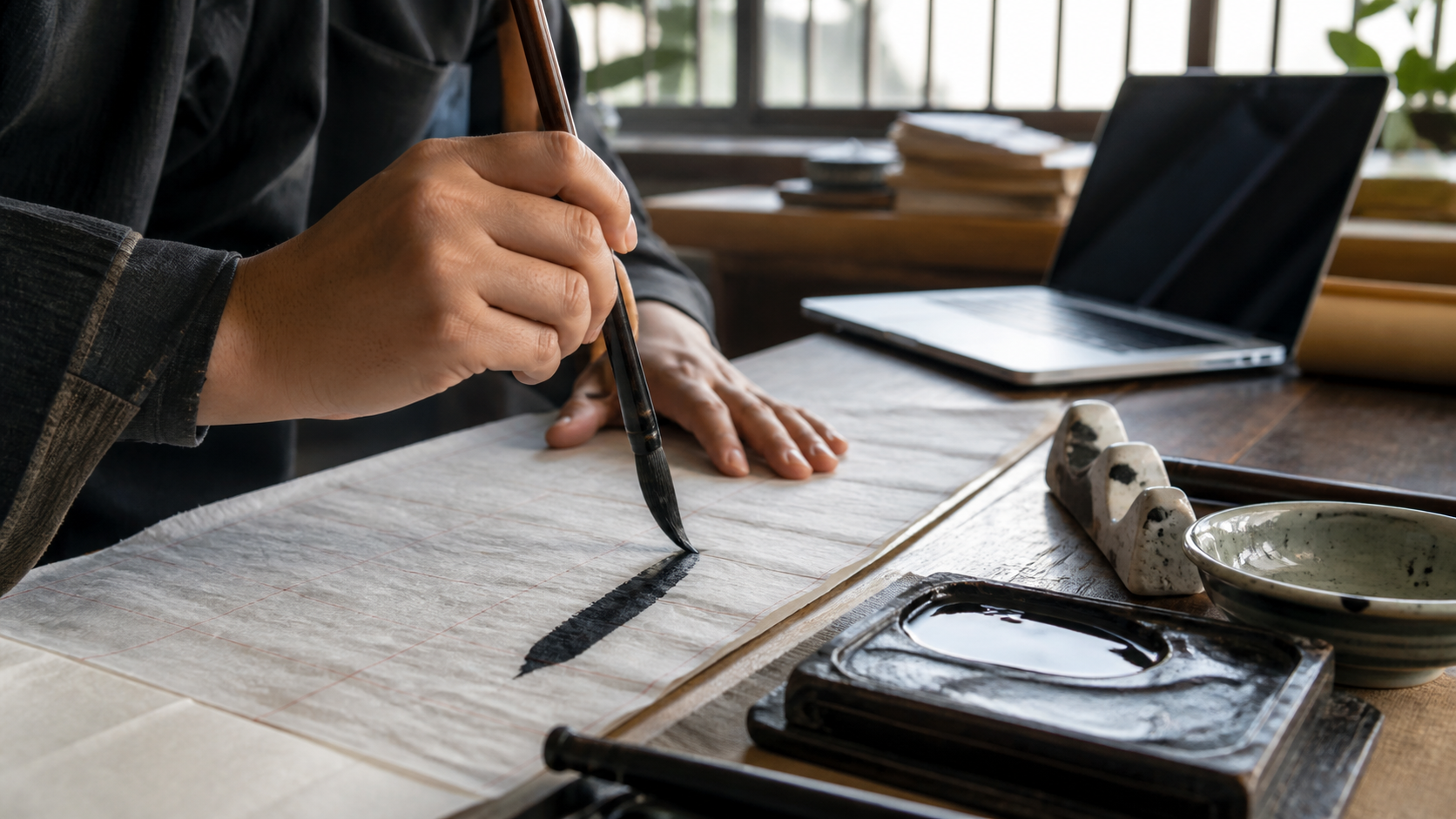
Phones have made people less likely to write long letters by hand, but they have not pushed calligraphy out of life. It has found new places in classrooms, exhibitions, and on screens.
When foreign readers first encounter Chinese calligraphy, they often take it for a beautiful typeface. Calligraphy values lines and structure, and it is also connected to the shape of Chinese characters, writing tools, and Chinese reading experience. The thickness of a brush, the density of ink, and how quickly paper absorbs moisture can all change the feeling of the same character. A work leaves both words and the movement of writing on the paper, making the movement itself something to look at.
In the digital age, input methods, keyboards, and speech-to-text send Chinese characters to screens quickly. Handwriting has become less necessary for recording words, but calligraphy has not disappeared. People still learn basic strokes at school, write couplets for festivals, practise copying model works in calligraphy classes, and view works in museums and on social platforms. It has moved from being part of everyday record-keeping toward a more visible role in education, aesthetics, and cultural practice.
Why calligraphy cannot be separated from Chinese characters
Chinese characters are not a simple arrangement of letters. Many have a visual balance in their structure. The direction of horizontal, vertical, left-falling, and right-falling strokes affects a character’s centre of gravity, while the width of its components has to correspond. Regular script, running script, and cursive script have different speeds of writing, structural arrangements, and aesthetic traditions. Foreign readers can understand them as different writing systems and should not see them only as decorative versions of one typeface.
Calligraphy also preserves traces of movement. The pressure of the brush as it touches the paper, the pause at a turn, and the way ink gradually fades all remain on the surface. A good work lets viewers see the character’s shape and imagine how the writer moved a wrist. Traditional Chinese theories of calligraphy often connected writing with a person’s character. That judgment belongs to a particular historical view, but it shows that calligraphy cares about the result and the process that produces it.
In 2008, Chinese calligraphy was included in China’s national list of intangible cultural heritage. In 2009, it was added to UNESCO’s Representative List of the Intangible Cultural Heritage of Humanity. Inscription did not seal calligraphy away. It confirmed that the tradition still needs to be continued through learning, teaching, and actual writing. Students who practise every day and teachers who continue to teach them are both part of its inheritance.
How digital screens help calligraphy become visible
Screens create a new way of looking. High-resolution images can enlarge the dry brush, variations in ink, and brush tips on paper. Online exhibitions allow people who cannot travel to Beijing or Shanghai to see ancient model texts and rubbings. Calligraphers demonstrate the beginning and ending of strokes and the arrangement of a composition in short videos, which beginners can watch repeatedly. This lowers the barrier to entry, but it has limits: a screen lacks the feel of paper, and an enlarged detail can make people forget the rhythm of the whole work.
Schools and public institutions are also trying to place calligraphy within broader cultural education. When children practise writing, they are learning about the structure of characters, ancient texts, and festival customs as well as making their handwriting neat. Copying a model work asks students to slow down and notice the relationship between one stroke and the next. In a digital environment that rewards speed, this training has value in itself. Calligraphy education should not judge only whether a character looks right. Understanding its meaning and feeling the rhythm of writing matter too.
Digital type design is another point of connection. Designers draw structures from seal, clerical, or running script and adjust the strokes for reading on screens. Games, film posters, and brand packaging also use calligraphic styles, but decorative use can compress a complex tradition into a single “Eastern” symbol. An accurate introduction should say which script a work belongs to, what it says, and in what setting it was used, rather than describing it only as “very Chinese.”
You do not have to become a calligrapher first
Foreign visitors can start with a work that includes a translation: read the content first, then observe the script and the direction of the strokes. If you join a workshop, focus on the tools and movements instead of trying to produce a perfect character at once. The brush, ink, inkstone, and paper form a small system. Changes in water, speed, and pressure quickly show beginners why calligraphy requires patience.
Chinese calligraphy still has a life in the digital age. Technology lets more people see it and also reminds them of the distinctiveness of a handwritten movement. It can be art in an exhibition, training in a classroom, a festival custom, or simply a period of slowing down for a while. Keyboards have changed how people record words, but they have not removed the need to look at lines, understand Chinese characters, and express oneself through writing.
https://www.youtube.com/watch?v=GpUqqtE2qUo
References
- Chinese Calligraphy (China Intangible Cultural Heritage Network) - China Intangible Cultural Heritage Network: Digital Museum of China’s Intangible Cultural Heritage

Peng Jinsui
I explore Chinese society, culture, travel, business, and language learning while studying Spanish and experimenting with AI and interactive products. I’m also open to helping people and organizations overseas better understand China, connect with local resources, and address practical needs.
Peng Jinsui