
Why Is China’s County Economy Receiving More Attention?
A county seat is not a smaller version of a big city. It connects townships, villages, factories, farmland, and local consumption.
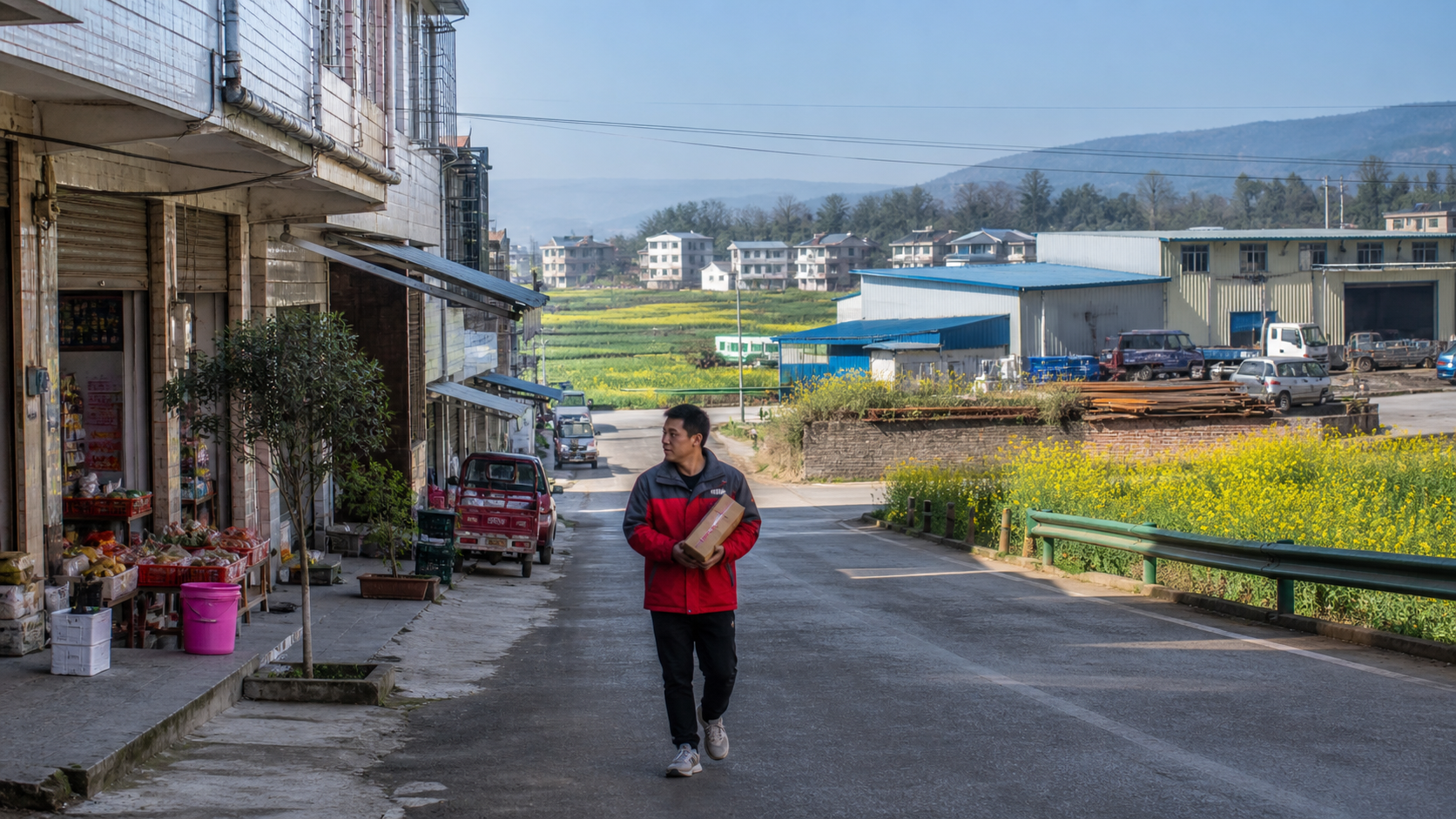
A county seat is not a smaller version of a big city. It connects townships, villages, factories, farmland, and local consumption.
In China’s administrative system, a “county” usually sits between cities and rural areas. The county seat concentrates public services, commerce, and jobs, while surrounding townships and villages provide labour, agricultural products, land, and ecological resources. To observe a county economy, you need to see how much industry the county seat has and how it connects these different spaces. Foreign readers who look only at Beijing, Shanghai, or Shenzhen can miss the fact that daily life for many Chinese people takes place within a county area.
County economies vary greatly in size and character. Some depend on manufacturing, some on agricultural processing, some on tourism and cultural resources, and some on logistics, e-commerce, or supporting industries because they are close to a major city. “County economy” is not a single industry. It uses the county-level administrative area as its scope and looks at industry, employment, consumption, and public services together.
Why the county seat becomes a connecting point
Residents of townships may need to go to the county seat to buy appliances, see a doctor, attend school, handle paperwork, or find work. Hospitals, schools, shops, banks, and transport stations in the county seat serve both people who live there and those from surrounding townships. As roads, delivery services, and internet connections improve, the county seat is also more closely linked to larger cities. A product made in a county can be sold nationwide through e-commerce, while a young person can work in the county and receive orders and information from elsewhere.
The county also plays an intermediate role in industrial relocation. Land and labour costs are higher in large cities, so some manufacturing and service businesses look for more suitable areas. If a county has transport, an industrial park, vocational education, and a stable labour force, it may be able to receive part of that industry. Once industry arrives, incomes and consumption change, and local services such as restaurants, repairs, logistics, and housing develop with them.
Counties are also using their own resources to develop distinctive industries, such as food processing, furniture manufacturing, farm machinery, cultural tourism, and Chinese medicinal herbs. The key is to turn resources into a longer industrial chain instead of selling only unprocessed materials. If a fruit-producing area has grading, cold-chain, packaging, and branding capacity, more value may remain with local farmers, processors, and logistics companies.
Why policy is paying special attention to county industries that benefit residents
County development is closely connected to the relationship between urban and rural areas. China’s 2025 No. 1 Central Document listed the expansion of county industries that enrich residents as a separate task. It emphasized distinctive rural industries, mechanisms linking farmers to industry, and broader channels for increasing farmers’ incomes. “Benefiting residents” asks whether industrial returns reach farmers and ordinary workers through jobs, orders, dividends, or services. It cannot be measured only by a county’s GDP.
China is experiencing population movement and urbanization, so counties face two needs at the same time. Some young people leave for study and work in big cities, while county seats need to retain and attract talent by improving education, healthcare, housing, and cultural life. County industries with only low-wage jobs struggle to keep technical professionals. Projects that chase only high-end investment cannot create broad income growth if local workers have no way to participate.
There are also large differences between counties. County-level cities along the eastern coast often have better transport and industrial foundations. Counties in central and western China may have ecological, energy, or cultural resources, but face greater distance from markets, shortages of talent, and higher financing costs. Regional cooperation, paired assistance, and e-commerce platforms can help, but outside capital cannot replace long-term local management. A project must ultimately be tested by demand and the environment in which it operates.
How can foreigners observe a Chinese county?
Start by looking at transport between the county seat and the townships, rather than only at the central square. Then look for real suppliers, workers, and customers behind local industries. Ask whether agricultural products have stable processing and logistics, and whether young people can find work that does not depend entirely on government departments. Public life in the county matters too. Schools, hospitals, markets, sports grounds, and cultural centres show whether industrial growth has become a more concrete change in daily life.
The county economy is receiving more attention because rural revitalization, urbanization, industrial relocation, farmers’ incomes, and local public services meet there. Understanding counties does not require finding one “successful model.” It is more useful to observe how China’s economy operates at different scales. Big cities provide capital, technology, and markets; county seats organize services and industry; townships and villages provide resources and the foundations of daily life. How smoothly these places connect often says more about the real local economy than the publicity around one project.
https://www.youtube.com/watch?v=TOeWJqQkiYs
References
- Full Text: County Economics in the New Era (Xinhua) - 2025 Study on High-Quality Development of China’s County Economy Released (Fujian Provincial Department of Industry and Information Technology) - China County Economic Development Report (Institute of Finance and Economics, Chinese Academy of Social Sciences)

Peng Jinsui
I explore Chinese society, culture, travel, business, and language learning while studying Spanish and experimenting with AI and interactive products. I’m also open to helping people and organizations overseas better understand China, connect with local resources, and address practical needs.
Peng Jinsui